

Elizabeth
Catlett
Mora
PROJECT


The granddaughter of former slaves, Catlett was raised in Washington, D.C. Her father died before she was born and her mother held several jobs to raise three children. Refused admission to Carnegie Institute of Technology because of her race, Catlett enrolled at Howard University, where her teachers included artist Loïs Mailou Jones and philosopher Alain Locke. She graduated with honors in 1935 and went on to earn the first MFA in sculpture and the first MFA as a black woman in the United States at the University of Iowa five years later.
Grant Wood, her painting teacher at Iowa, encouraged students to make art about what they knew best and to experiment with different mediums, inspiring Catlett to create lithographs, linoleum cuts, and sculptures in wood, stone, clay, and bronze. She drew subjects from African American and later Mexican life.
In 1946, a grant from the Rosenwald Foundation enabled Catlett to move to Mexico City with her husband, printmaker Charles White. There she joined the Taller de Gráfica Popular, an influential and political group of printmakers. At the Taller, Catlett met the Mexican artist Francisco Mora, whom she married after divorcing White and with whom she had three sons.
Catlett taught at the National School of Fine Arts in Mexico City from 1958 until her retirement in 1976, producing realistic and highly stylized two- and three-dimensional figures. Her subjects ranged from tender maternal images to confrontational symbols of the Black Power movement, to portraits of Martin Luther King Jr. and the writer Phyllis Wheatley.
During the past 40 years, museums and galleries have held more than 50 solo exhibitions of Catlett’s sculptures and prints, including important retrospectives in 1993 and 1998. Catlett continued to make art through her mid-90s, while dividing her time between New York and Cuernavaca (National Museum of Women in the Arts, 2023).
Biography

Artist Catalog

All artwork on this site is by my grandmother political artist and activist, Elizabeth Catlett Mora.
I draw inspiration from her courage and desire to uplift black and brown people and show them their beauty through her art.


Francisco
Mora
Mora was a member of the "Mexican School" of mural artists. Other artists involved included Carlos Mérida, Francisco Zúñiga, Pablo O'Higgins and Elizabeth Catlett Mora. Since the 1950s, Mora has exhibited his paintings and lithographs in Mexico and abroad.


Biography
My Grandfather, Mexican indigenous painter and printer maker Francisco Mora, was born in Uruapan, Michoacán. In 1941, Mora relocated to Mexico City where he won a scholarship to study at the art school, La Esmeralda, where he was a pupil of Diego Rivera. Later in the same year, he began exhibiting with the Taller de Gráfica Popular,a communal graphics workshop founded by artists Leopoldo Méndez, Pablo O'Higgins and Luis Arenal that built on Mexico's rich tradition of political printmaking in order to advance revolutionary political and social causes.[4] Mora remained a member of the TGP collective until 1965. During this time, his artistic focus was on social justice; making posters for trade unions and government literacy campaigns.

Artwork


“No other field is closed to those who are not white and male as is the visual arts. After I decided to be an artist, the first thing I had to believe was that I, a black woman, could penetrate the art scene, and that, further, I could do so without sacrificing one iota of my blackness or my femaleness or my humanity.”
~ Elizabeth Catlett
Video Archive
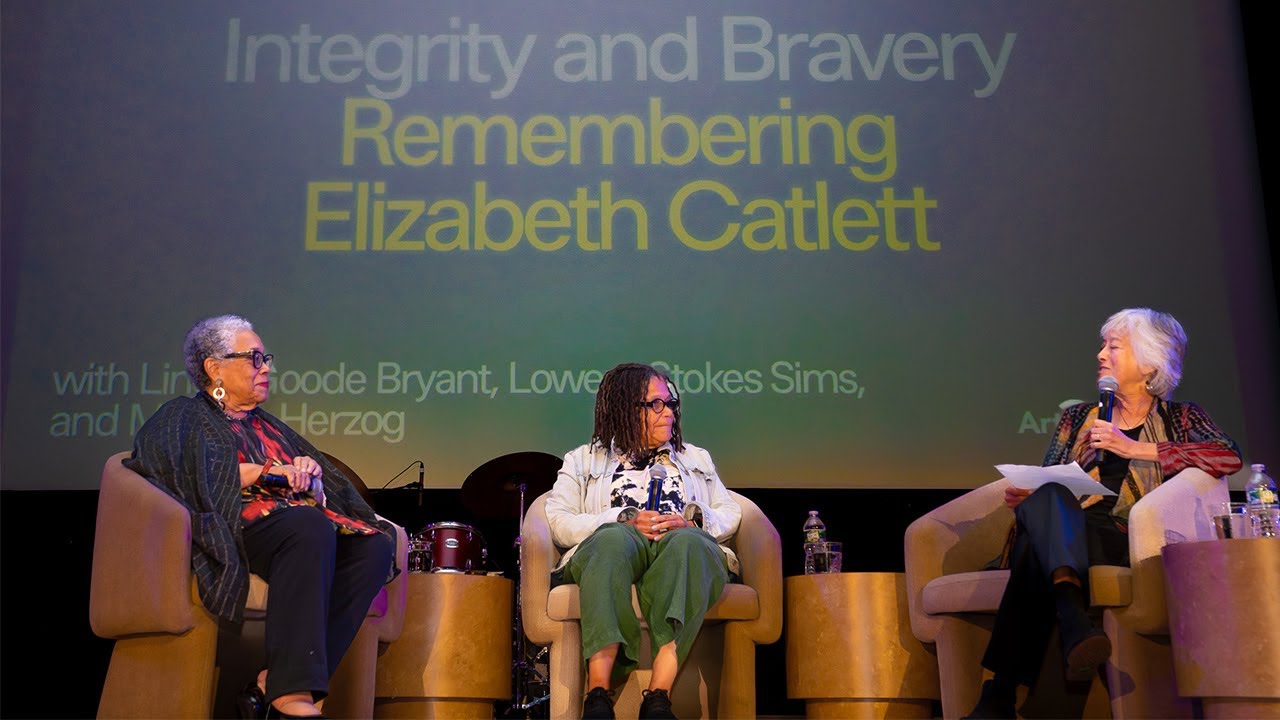
Elizabeth Catlett Mora: In her own Words


legacy & creative inheritance
.jpg)
.jpg)


Press


How Elizabeth Catlett Lifted Up Black Women Through Art
The pioneering sculptor defied trends to honor the daily lives of her subjects


Stella Jones G
Legacy of Elizabeth Catlett